Hello World KitchenBeta
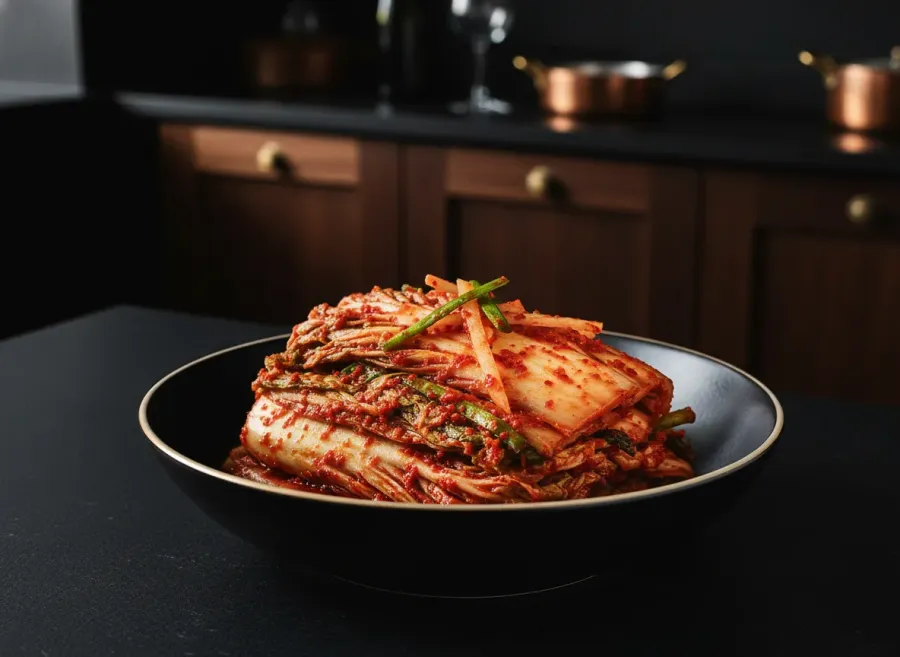
Authentic, deeply flavorful traditional Korean napa cabbage kimchi. This recipe covers the essential techniques of properly brining the cabbage, making a rich umami gochugaru paste, and the initial fermentation process to develop complex, probiotic-rich flavors.
Ingredients
Cabbage and Brine
- 2 large heads Napa cabbage — About 4-5 lbs total
- 1 cup Coarse Korean sea salt — Do not use table salt; use coarse sea salt (cheonilyeom)
- 4 cups Water — For dipping the cabbage to help salt adhere
Sweet Rice Porridge
- 2 cups Water — For the porridge base
- 2 tablespoons Sweet rice flour (glutinous rice flour) — Mochiko or chapssalgaru
- 2 tablespoons Sugar or brown sugar — To help feed the fermentation bacteria
Kimchi Paste (Yangnyeom) & Vegetables
- 0.5 cup Garlic — Peeled cloves
- 2 teaspoons Ginger — Peeled and minced
- 1 medium Onion — Roughly chopped
- 0.5 medium Asian pear or Fuji apple — Peeled, cored, and roughly chopped
- 0.5 cup Fish sauce — Korean anchovy or sand lance fish sauce
- 0.25 cup Saeujeot (Korean salted fermented shrimp) — Minced
- 2 cups Gochugaru (Korean red chili flakes) — Adjust to desired spice level
- 2 cups Korean radish (Mu) — Julienned or cut into matchsticks
- 7 stalks Scallions — Cut into 1-inch pieces
Instructions
-
Cut the cabbages lengthwise in half, then cut a short slit at the base of each half. Gently pull the halves apart to split them into quarters. This preserves the leaves.
~5 minTearing the cabbage after cutting the base prevents the leaves from being unnecessarily shredded. -
Dunk the cabbage quarters in a large basin of water to get them wet. Sprinkle the coarse sea salt between the leaves, concentrating more salt near the thicker stem ends. Let rest in a basin for 2 hours, turning them over every 30 minutes to ensure even salting.
~2hThe cabbage is ready when the thickest white parts of the leaves are flexible and bend without snapping. -
Rinse the salted cabbage quarters thoroughly in cold water 3 times to remove excess salt. Drain them cut-side down in a colander for at least 30 minutes to remove as much water as possible.
~30 minSqueeze the cabbage gently to expel extra water; too much water will dilute the kimchi paste. -
While the cabbage drains, make the sweet rice porridge. In a small saucepan, whisk together 2 cups of water and 2 tablespoons of sweet rice flour. Bring to a boil over medium heat, stirring constantly until bubbles form and the mixture thickens slightly. Stir in the sugar, cook for 1 more minute until translucent, then remove from heat and let cool completely.
~10 minThe porridge acts as a binder for the spices and provides food for the lactic acid bacteria during fermentation. -
In a food processor or blender, combine the garlic, ginger, onion, Asian pear, fish sauce, and salted shrimp. Blend until smooth.
~5 min -
In a large mixing bowl, combine the cooled sweet rice porridge, the blended garlic-ginger mixture, and the gochugaru. Stir well to form a thick, vibrant red paste. Fold in the julienned radish and scallions.
~10 minLet the paste sit for a few minutes so the gochugaru rehydrates and the flavor deepens. -
Put on food-safe gloves. Take a quarter of the drained cabbage and rub the paste generously over every leaf, starting from the outside and working in, concentrating more paste on the thicker stem ends. Fold the quarter in half and pack it tightly into a clean glass jar or kimchi container.
~15 minPress down firmly on the packed cabbage to remove air pockets. -
Leave about 1.5 to 2 inches of headspace at the top of the jar to allow for expansion during fermentation. Close the lid tightly.
~2 min -
Leave the jar at room temperature (out of direct sunlight) for 1 to 2 days to kickstart fermentation. You will see bubbles forming and juices rising. Once it smells sour and tastes ripe to your liking, move it to the refrigerator to slow down fermentation.
~48hOpen the jar once a day during room temperature fermentation to let the accumulated gas escape ('burp' the jar), and press down the kimchi to keep it submerged in its brine.
Nutrition
Equipment
- Large basin or bowls
- Colander
- Food processor or blender
- Small saucepan
- Knife and cutting board
- Gloves (for mixing)
- Airtight glass jars or kimchi containers
Tips & Storage
- Always wear gloves when rubbing the paste onto the cabbage to prevent burning your skin.
- For a vegan version, substitute fish sauce with soup soy sauce or a vegan fish sauce, and omit the salted shrimp.
- The longer kimchi ferments in the fridge, the sourer it gets. Very sour kimchi is excellent for making kimchi jjigae (stew) or kimchi fried rice.
- Storage: Store in airtight jars in the refrigerator for up to several months. As it ages, it will become softer and more sour. Keep the kimchi pushed down under its liquid to prevent mold.
Tags
🤖 This recipe was created with AI assistance. If you spot a mistake or something that doesn't look right, please report it.