Hello World KitchenBeta
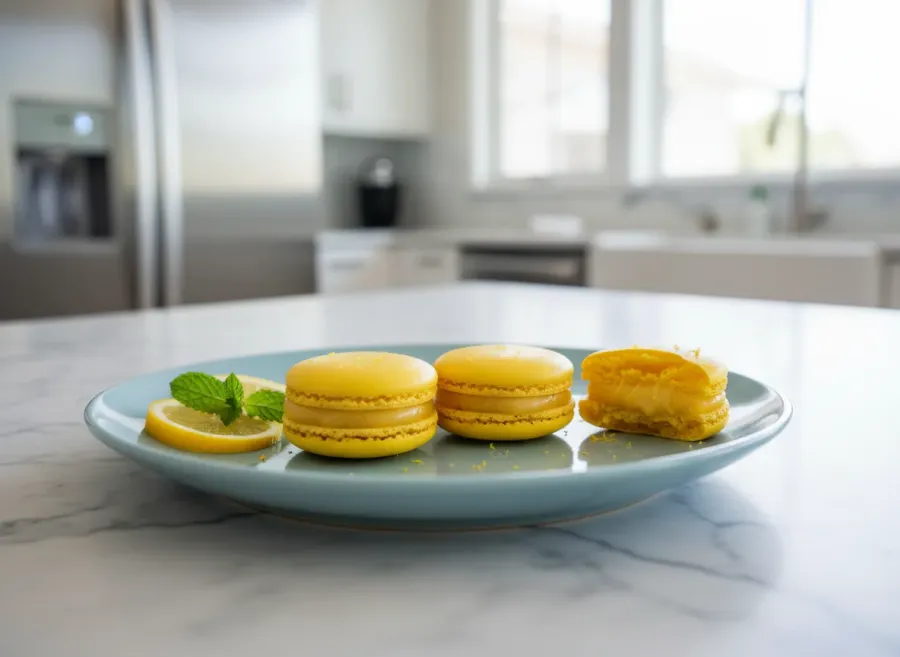
Expert-level, delicate French macarons featuring perfectly footed, crisp yet chewy yellow shells filled with a brightly tart and silky homemade lemon curd. This recipe uses the traditional French meringue method and provides detailed guidance on the delicate macaronage process.
Ingredients
Macaron Shells
- 130 grams Almond flour — Super fine, blanched
- 130 grams Powdered sugar — Also known as confectioners' sugar
- 100 grams Egg whites — Aged for 24 hours in the fridge, brought to room temperature
- 90 grams Granulated sugar — Superfine if possible
- 0.25 teaspoons Cream of tartar (optional) — Helps stabilize the meringue
- 2 drops Lemon yellow gel food coloring — Do not use liquid food coloring
Tart Lemon Curd Filling
- 4 large Egg yolks — Room temperature
- 130 grams Granulated sugar
- 80 ml Lemon juice — Freshly squeezed (about 2-3 lemons)
- 1 tablespoon Lemon zest — Freshly grated
- 85 grams Unsalted butter — Cut into small cubes, room temperature
- 1 pinch Salt
Instructions
-
Prepare the lemon curd: In a medium heat-proof bowl, whisk together the egg yolks, granulated sugar, lemon juice, lemon zest, and salt until smooth. Place the bowl over a saucepan of simmering water (double boiler), ensuring the water doesn't touch the bottom of the bowl. Whisk continuously until the mixture thickens and coats the back of a spoon (about 170°F/76°C).
~10 minDo not stop whisking, or the eggs may scramble. -
Remove the curd from heat and immediately strain through a fine mesh sieve into a clean bowl to remove zest and any cooked egg bits. Whisk in the room temperature butter pieces until fully melted and emulsified. Cover with plastic wrap pressing directly onto the surface of the curd to prevent a skin from forming. Chill in the refrigerator until set.
~5 minMake the curd a day in advance for the best firm consistency. -
Prepare the dry ingredients: Weigh the almond flour and powdered sugar. Sift them together through a fine mesh sieve into a large bowl. Discard any large almond pieces that do not pass through. Whisk the sifted mixture to ensure it is fully combined.
~10 minFor exceptionally smooth shells, pulse the almond flour and powdered sugar in a food processor 5-6 times before sifting. -
Whip the meringue (French Method): In a meticulously clean, grease-free mixer bowl, beat the room-temperature egg whites on medium-low speed until foamy. Add the cream of tartar. Gradually add the granulated sugar, 1 tablespoon at a time, while increasing the speed to medium. Once all sugar is added, beat on medium-high until stiff, glossy peaks form.
~8 minThe meringue should clump inside the whisk and stand straight up without drooping when the whisk is inverted. -
Add the gel food coloring to the stiff meringue and whip for 10-15 seconds just to combine. Do not overmix.
~1 minAdd slightly more color than you want the final shells to be, as the color fades slightly during baking. -
Macaronage: Add half of the dry ingredients to the meringue. Fold gently using a silicone spatula, scraping around the bowl and down the middle. Add the remaining dry ingredients and continue folding. As the dry ingredients incorporate, begin pressing the batter gently against the sides of the bowl to deflate some of the air. Stop folding when the batter flows off the spatula in a continuous, thick ribbon like slow-moving lava, allowing you to draw a 'figure 8' without the stream breaking.
~5 minCheck consistency frequently. One fold too many can ruin the batter. It should take about 10 seconds for a drizzled ribbon to meld back into the rest of the batter. -
Pipe the shells: Transfer the batter to a piping bag fitted with a round tip (about 1/2 inch opening). Hold the bag completely vertical about 1/2 inch above a silicone baking mat-lined baking sheet. Squeeze gently to form 1.5-inch circles, leaving 2 inches of space between them. Release pressure and swiftly pull away in a small circular motion to avoid tails.
~10 minPlace a printed macaron template under your silicone mat for uniform sizes, but remember to remove it before baking! -
Tap the baking sheets firmly on the counter 4-5 times to release trapped air bubbles. Pop any visible surface bubbles with a toothpick.
~2 minSlamming the tray is crucial; otherwise, trapped air will expand in the oven and crack the shells. -
Rest the shells: Let the piped macarons sit at room temperature until a dry skin forms on the surface. You should be able to gently touch the top of a shell without any batter sticking to your finger. This usually takes 30-60 minutes depending on humidity.
~45 minIf your kitchen is very humid, use a fan on a low setting or a dehumidifier to help them dry. -
Preheat the oven to 300°F (150°C). Use an oven thermometer to ensure accuracy, as oven displays are often incorrect.
Macarons are extremely temperature sensitive. Too hot, and they brown or crack; too cold, and they don't develop 'feet'. -
Bake one sheet at a time in the center of the oven for 14-16 minutes. At the halfway point, quickly rotate the pan 180 degrees for even baking. To test for doneness, gently nudge the top of a shell; it should not wiggle significantly from its feet.
~15 minIf they wiggle a lot, bake for 1-2 more minutes. Let them cool completely on the baking sheet before attempting to remove them. -
Assemble: Once the shells are completely cool, peel them carefully off the mat. Match them up by size. Transfer the chilled lemon curd to a piping bag. Pipe a dollop of lemon curd onto the center of the flat side of one shell, and gently press a matching shell on top until the filling reaches the edges.
~10 minFor a neater look, pipe a ring of lemon buttercream around the edge and fill the center with the lemon curd. -
Maturation: Place the assembled macarons in an airtight container and refrigerate for 24 hours before eating. This allows the shells to absorb moisture from the filling, creating the signature crisp exterior and chewy, melt-in-your-mouth interior.
Bring to room temperature for 15-20 minutes before serving for the best texture.
Nutrition
Equipment
- Kitchen scale
- Stand mixer or electric hand mixer
- Fine mesh sieve
- Silicone spatula
- Piping bags
- Round piping tip (e.g., Wilton 12)
- Baking sheets
- Silicone baking mats or parchment paper
- Oven thermometer
- Medium saucepan
Tips & Storage
- Always weigh your ingredients in grams. Volume measurements (cups) are not precise enough for macarons.
- Egg whites whip better and are more stable if they are 'aged'. Separate them a day in advance, keep them in a covered container in the fridge, and bring to room temp before whipping.
- Lopsided shells are usually caused by uneven piping pressure, an uneven oven fan, or a baking pan that is warped.
- Cracked shells indicate that either the batter was under-mixed (too much air), the shells didn't rest long enough to form a skin, or the oven temperature was too high.
- Hollow shells can result from an over-whipped meringue, under-baking, or an oven temperature that is too low.
- Storage: Store assembled macarons in an airtight container in the refrigerator for up to 4 days. Unfilled shells can be frozen in an airtight container for up to 1 month; thaw at room temperature before filling.
Tags
🤖 This recipe was created with AI assistance. If you spot a mistake or something that doesn't look right, please report it.